Showing posts with label dream photo. Show all posts

Monday, 17 May 2010

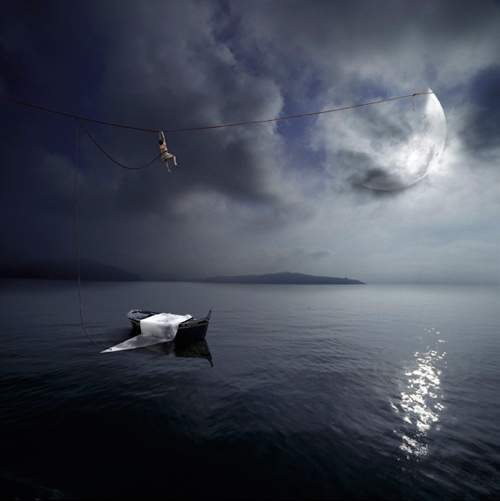
Oleksandr Hnatenko - Surreal moment in photography


Maybe you know him from Deviant Art as “gnato”, but his real name is Oleksandr Hnatenko, that’s why OH! Photography. Oleksandr was born in Zolochiv, Ukraine, in August 27th 1986. Now, he lives and works in Vienna, Austria. 
 Getting his first camera at the age of 8 he tried to take photos at his uncle’s wedding. After taking the pictures he realised that there was no film in the camera. That’s his first approach with photography. 
 After years, He tried taking pictures again. Oleksandr, through his photography is looking for reality, but do this in his own way. Lots of things come across during his search, some are simple, some old, some new, some that are eye-catching, in colour or in monochrome, visible things and some hidden from view, some things with sense and some without.
 Surreal moments are born out of this. They exist in the imagination of Oleksandr Hnatenko and they take form in his photos.
Forse lo conoscete da Deviant Art come “gnato”, ma il suo vero nome è Oleksandr Hnatenko, da qui il nome OH! Photography. Oleksandr nasce a Zolochiv, in Ucraina, il 27 agosto del 1986. Oggi lavora e vive a Vienna. Ebbe la sua prima macchina fotografica all’età di otto anni e cercò di scattare foto al matrimonio dello zio, ma alla fine della cerimonia si accorse di non aver messo il rullino nella macchina fotografica. Oleksandr, attraverso la fotografia, guarda la realtà, ma lo fa a modo suo. Durante la sua ricerca ha incontrato molte cose, alcune semplici, altre vecchie, altre nuove, altre che attirano l’attenzione per I colori, cose visibili e cose nascoste. Da ciò sono nati momenti surreali che esistono prima nell’immaginazione dell’artistta e che prendono forma nelle sue opere.


For further information see also http://www.pohtography.com/ and http://gnato.deviantart.com/ .
All the works posted here are from Oleksandr Hnatenko.

Wednesday, 12 May 2010

Stéphane Pellennec - Photography and dream


Hi everyone! Today I have an interview with an other Finish artist! Enjoy it!


- Can you tell us something about yourself? When did you discover your passion for Photography?
I'm a dreamer and as a child I was the kind of guy at school you could call a dreamer, the one in his own world, drawing small signs on paper while the teacher explained important things, dreaming looking at the wind moving the branches behind the classroom window... and this until I got to military service. I met there a photographer who was so passioned, he gave me interest in photography, not only as a viewer but also as the one taking the picture. Before I've had some pocket camera and wasn't satisfied about results and could think about photography as a way to express my mind as drawing was, but this man has shown me that with a manual reflex camera, everything is possible. So I asked for a cheap manual reflex camera in 1996 for Christmas. We weren't yet in the digital age and I've learned a lot, read, tried... and my passion did grow up all the time, and it still grows up, I'm still learning and trying, going from analog to digital, from digital to medium format analog, learning to develop negatives...

- What are your main sources of inspirations?
I feel inspired when I feel good and relax and it happens when it is peaceful around and often in the nature. I love to walk on shores, to observe relations between elements, between humans and elements, nature and elements, human and nature... Water is very important.

- What do you want to transmit to people with your works ?
Most of the time I don't make works to transmit things to people, I make works just as I would draw my mind on a piece of paper, for myself, for trying to put my mind, my dreams, on black on white, to get back to myself and dreamy world.

- What is the work that you are more attached? Why?
Strangely the work I'm the most attached to isn't the most typical from me, but there are so many feelings behind this one, how I felt during the moment I took it and what beginning it meant for me and my love, which make this one to be the one, if I need to choose one:


- Può raccontarci qualcosa sulla sua vita? Quando ha scoperto la sua passione per la fotografia?
Io sono un sognatore e quando ero un bambino a scuola ero quell tipo di ragazzo che si può chiamare sognatore. La persona che si mette a tracciare segni sulla carta mentre l’insgnante spiega cose importanti, quella che sogna guardando il vento muovere i rami dietro la finestra.. e così fino al servizio militare, dove incontrai un fotografo che era così appassionato da trasmettermi il suo interesse nella fotografia, non solo come spettatore, ma come colui che sta dietro all’obiettivo. Prima di allora avevo una macchina fotografica compatta, non ero soddisfatto dei risultati, ma non pensavo alla fotografia come modo per esprimere me stesso. Ma quell’uomo ma ha fatto capire che con una reflex manuale ogni cosa è possibile. Così nel Natale del 1996 chiesi in regalo una reflex manuale da pochi soldi. Non era ancora arrivata l’era digitale. Da allora ho imparato molto, leggendo e provando, e ancora oggi continuo ad imparare e la mia passione aumenta di giorno in giorno. Provo a cambiare da analogico a digitale e viceversa, imparo a sviluppare negativi …

- Quali sono le sue principali fonti d’ispirazione?
Mi sento ispirato quando sto bene e sono rilassato, e questo succede quando attorno a me c’è pace e spesso anche natura e verde. Amo camminare sulla spiaggia, osservare relazioni tra gli elementi, tra esseri umani ed elementi, tra la natura e gli elementi, tra la natura e gli esseri umani.. l’acqua è importante.
- Cosa vuole trasmettere alle persone con I suoi lavori?
Di solito non eseguo I miei lavori per trasmettere qualcosa alle persone. Fotografo allo stesso modo di come disegnerei la mia mente su un pezzo di carta, per me stesso, per cercare di rappresentare la mia mente, I miei sogni in bianco e nero. Per ritorvare me stesso e il mio mondo di sogni.

-Qual’è il lavoro a cui sei più affezionato? Perché?
Stranamente il lavoro a cui sono più affezionato non rappresenta il mio lavoro tipico. Ma racchiude così tante emozioni. Come mi sono sentito in quella circostanza e cosa ha significato quel momento per me.

Stéphane Pellennec was born in 1971 in France, but works and lives in Finland with his family.
For further nformation see also http://www.elucubrations.eu/ and http://jakezdaniel.deviantart.com/
All the images postedi here are by Stéphane Pellennec.


Wednesday, 14 April 2010

Alastair Magnaldo - Dream scenary and photo manipulation


Today, I want to present a French photographer: Alastair Magnaldo. In his images (Some are posted here) he created these sceneries similar to dreams or visions.
In order to make them he takes 7 hours: about half an hour scanning, six hours in all for the computer work and about another half hour for the print. The most harder thing for the artist is to show every detail on a 40x40 print. He starts writing down the ideas, sketching the scenes, and making lists of elements he needs. For his sceneries, it often means waiting for the ideal situation, maybe collecting elements in the outside world. Than he begins the computer work that consist of assembling, positioning, orienting and colour matching, and “cleaning-up” work on the details. Here the difficulty is to find a compromise between the initial idea and its translation into the image.
Although the manipulation process for the artist this remain photography not only because every piece of the composition is a photograph, but the process of fixing “something” is exactly the same as more traditional photographers.

Oggi vorrei presentare un fotografo francese: Alastair Magnaldo. Nelle sue immagini (alcune delle quail sono postate qui) egli crea degli scenari simili a sogni o visioni. Per completare un lavoro ci vogliono 7 ore: circa un’ora e mezza di scansione, sei ore per il lavoro al computer e un’altra ora e mezza per la stampa. La cosa più difficile per l’artista è mostrare ogni dettaglio in una stampa 40x40. Incomincia scrivendo le idée, facendo uno schizzo della scena e una lista degli elementi che gli servono. Per le sue opere spesso significa aspettare per la situazione ideale e collezionare elementi dal mondo. Dopo di che inizia il lavoro al compiuter: posizionare, orientare e aggiustare I colori, infine ripulire l’intero lavoro. Qui la difficoltà principale risiede nel trovare un compromesso tra  l’idea iniziale e la sua trasformazione in immagine. Nonostante la manipolazione del lavoro, per l’artista questa rimane ancora fotografia non solo perchè ogni pezzo della composizione è una fotografia, ma soprattutto perchè il prcesso consiste nel “fissare” qualcosa ed è lo stesso della fotografia tradizionale.

For further information see also www.almagnus.com


Related Posts Plugin for WordPress, Blogger...